


Today for you
One unit, 10 to 15 minutes
Cards that are due, questions on your weak rules and the next unit of your learning path, sized by your exam date and recent results. The same unit all day; recomputed after each session.
For the Solicitors Qualifying Examination
Lexxington is a study app for future solicitors in England and Wales. Work through scenarios step by step, review the rules with flashcards and read the statutes and leading cases behind each answer. Every FLK1 and FLK2 subject of SQE1.
Contract Law
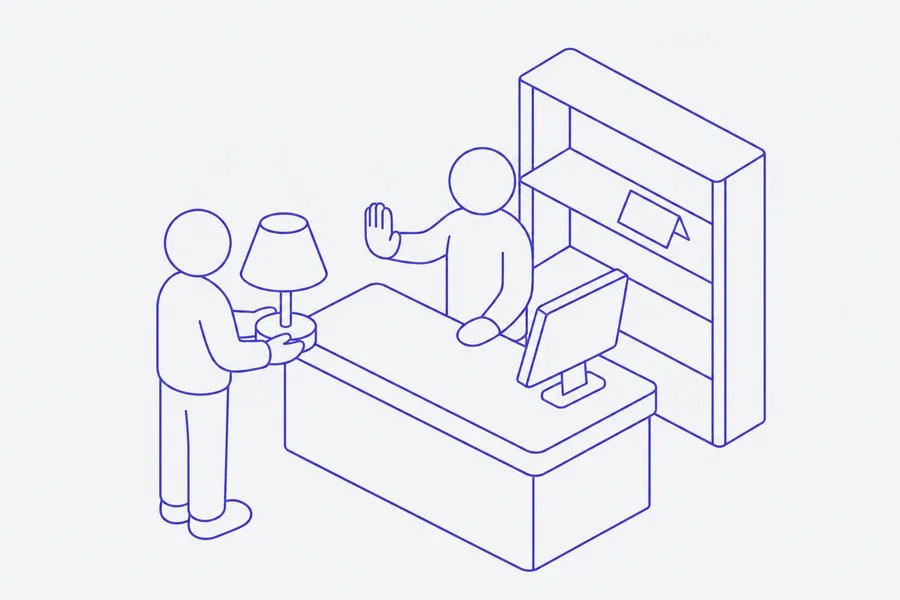
Ahmed offers to sell his narrowboat to Beth for £30,000. Beth replies by email: 'I will pay £27,000.' Ahmed refuses. Two days later Beth emails again: 'Fine, I accept your offer at £30,000.' Ahmed has since had a better offer and says no contract exists.
Beth's later email accepting £30,000 creates a binding contract.
A case from the app, exactly as it appears there. In the app, more statements follow, with the rule and the reasoning.
Cases, cards, the rules, timed practice and a tutor work together. Every answer leads to the rule, every rule to its cases.
Try your first case in the app
For iPhone and iPad. With a subscription in the browser too, with the same account.
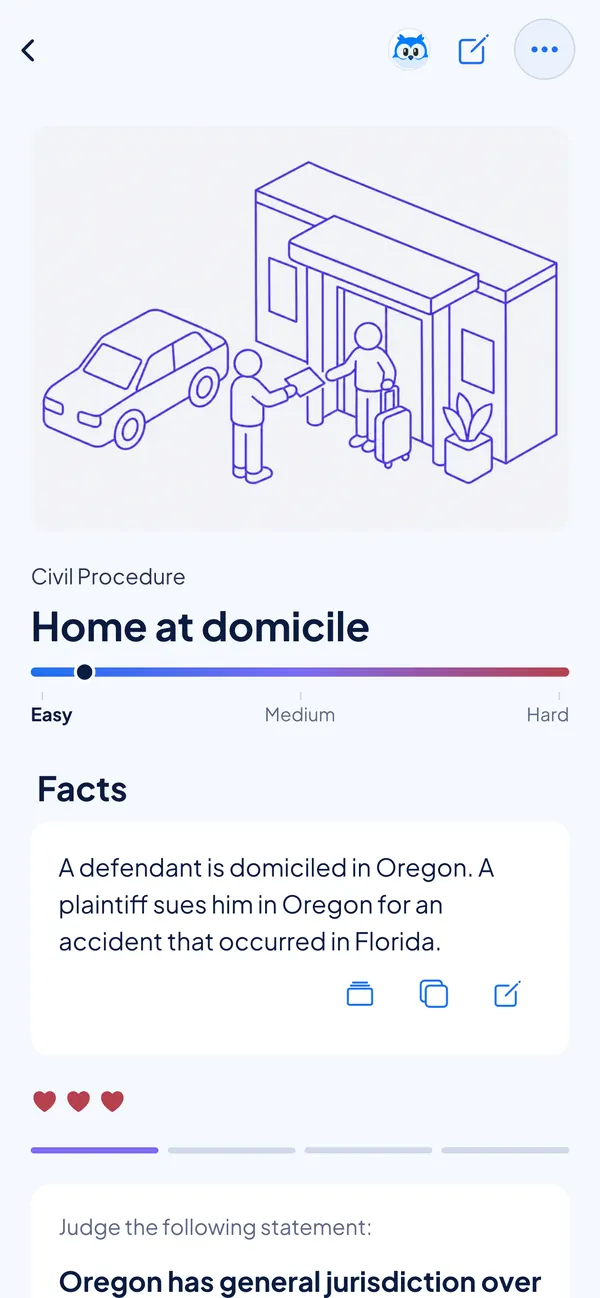
Product tour
Real views from the app with test data. Scroll through the steps and the phone follows.
Your plan for today: cards that are due, a few questions and the next unit, sized to your exam date.
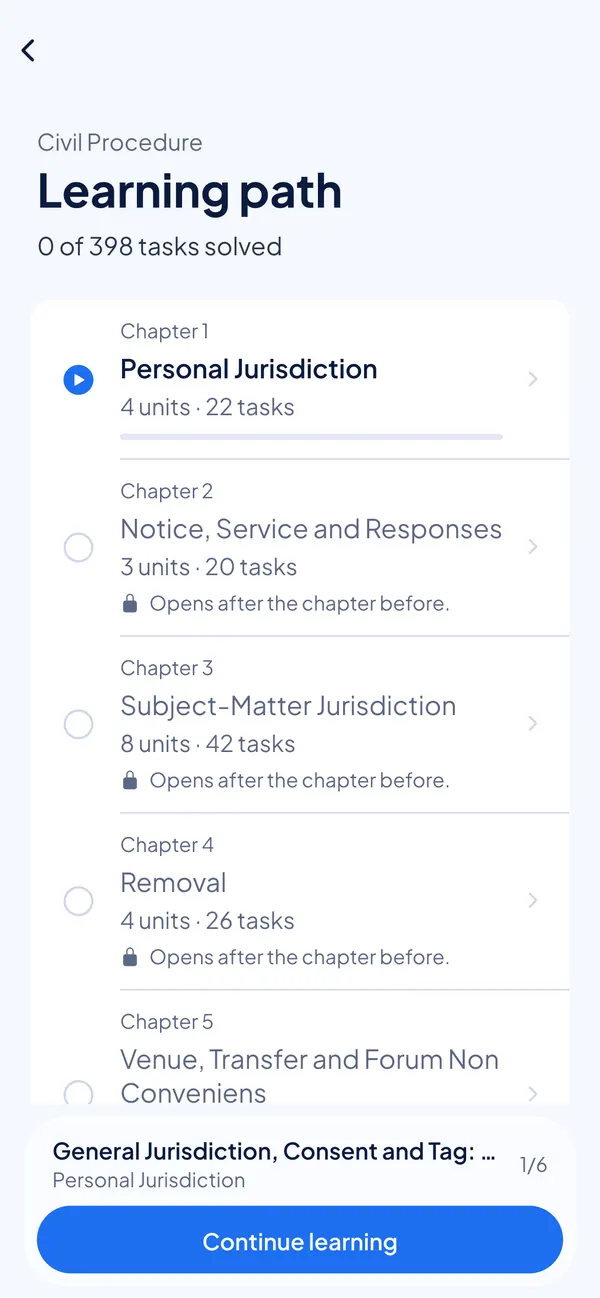
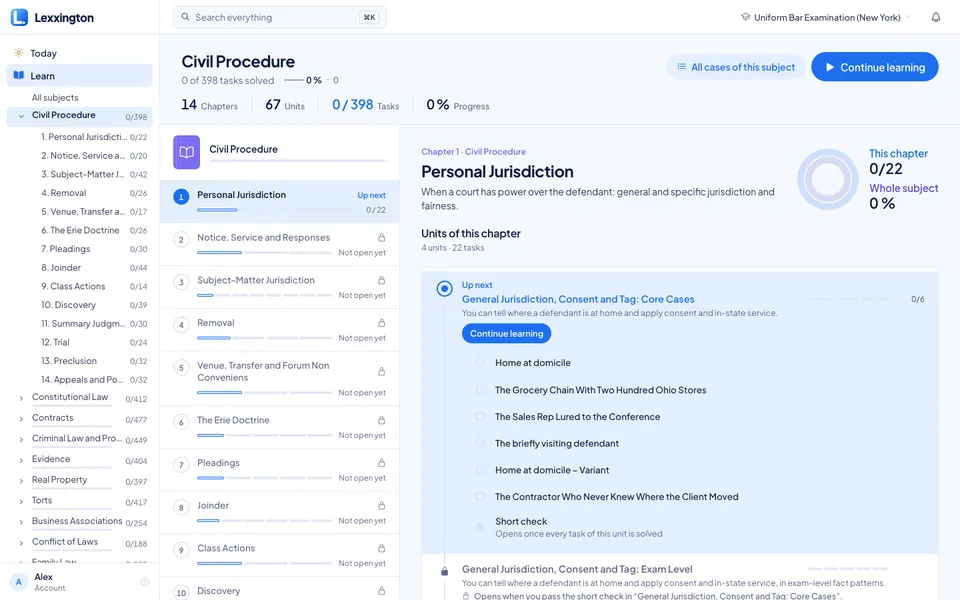
Chapter by chapter through the material. Each unit opens the next.
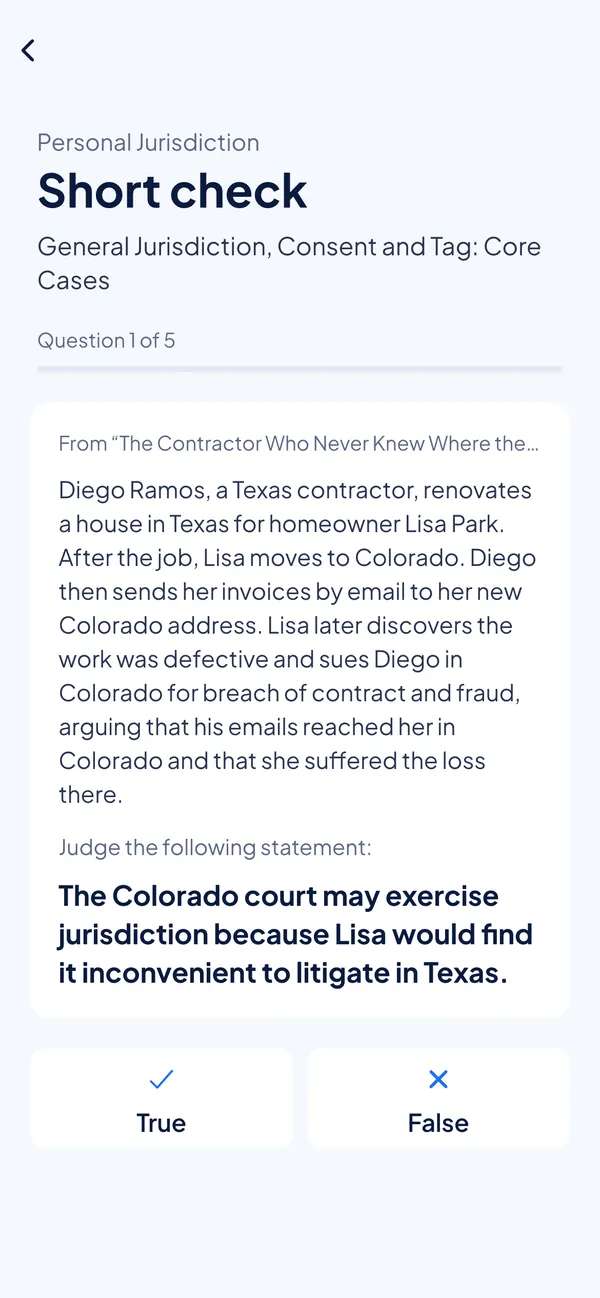
Read the facts, judge the statement, then see the reasoning with the rule.
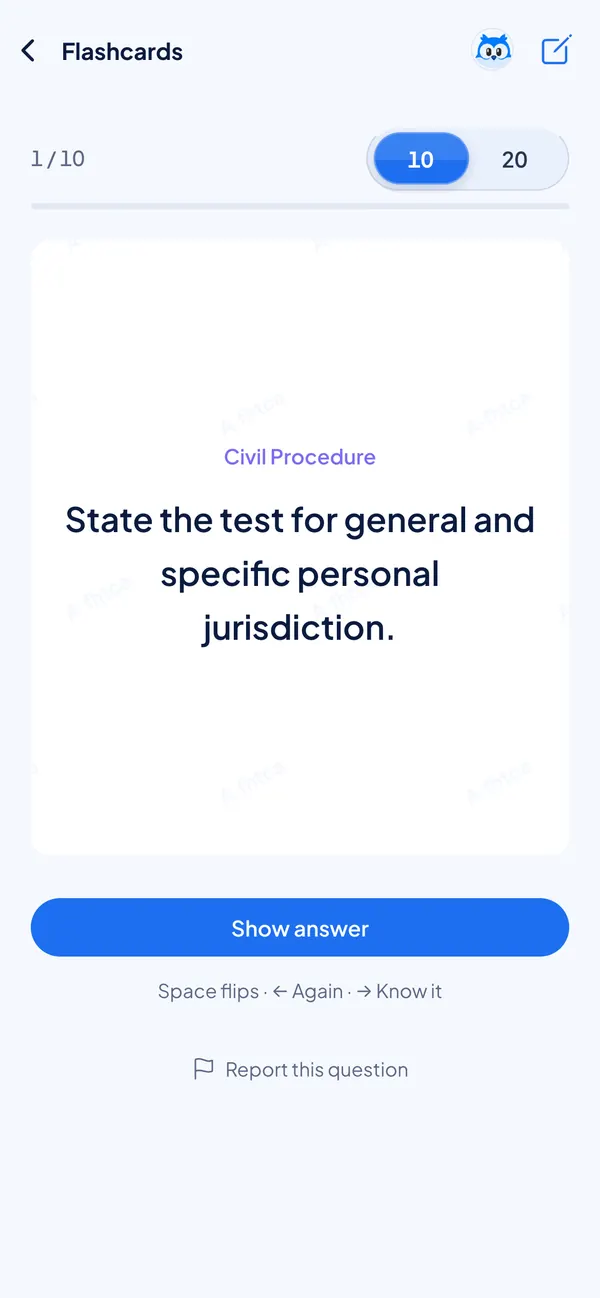
Answer yourself first, then reveal and rate. What is shaky comes back sooner.
Five statements after each unit show whether it has stuck.
The rule in full, with reading level, exam relevance and the cases on it.
The rules you missed most often, and your weakest subjects.
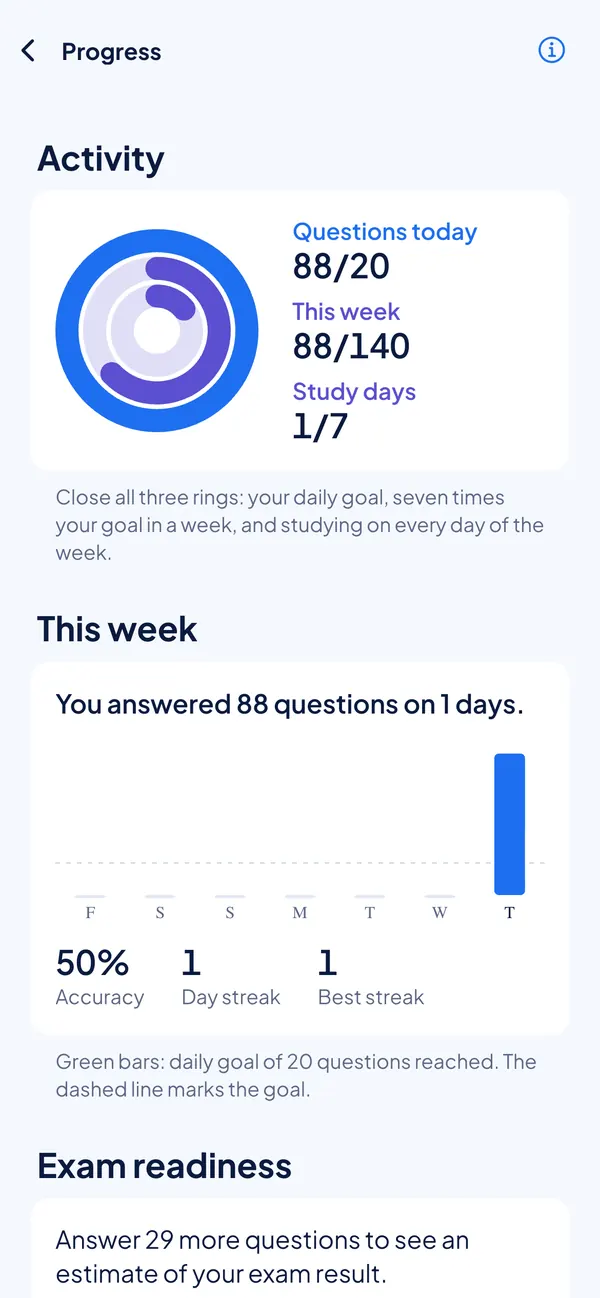
Daily goal, streak and exam readiness at a glance.
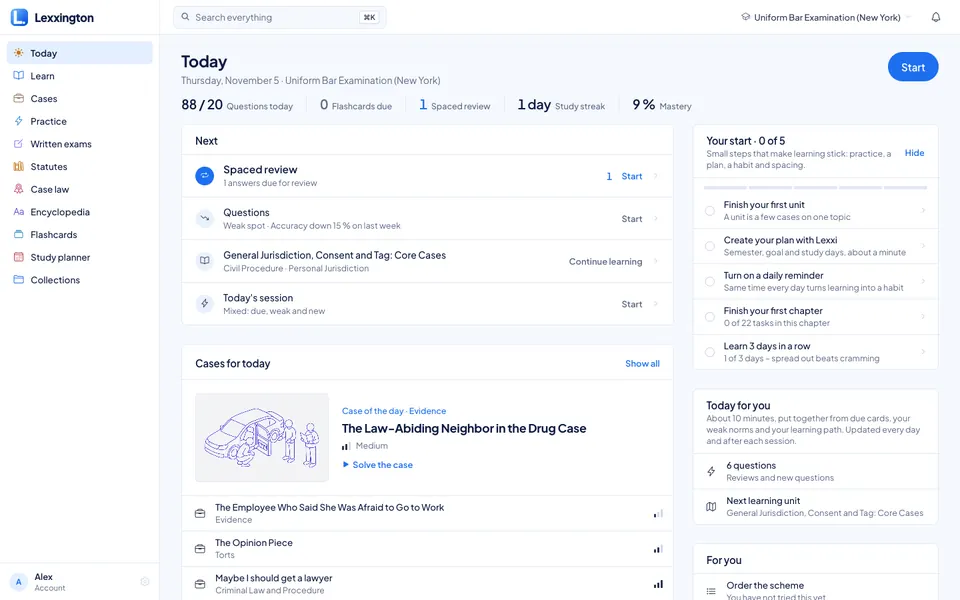
Web app
With a subscription you can also study in your browser, with the same account and progress.
Counted from the course files: cases, questions and flashcards per subject. Each subject keeps the colour it has in the app.
casesquestionsflashcards
Lexxi, the AI tutor
Lexxi answers questions about the material in plain words, drawing on the app’s knowledge base. Every answer names the rules, so you can check it.
The rules and decisions the answer relies on, ready to read.
After a wrong answer, Lexxi explains the question another way or answers your follow-up.
Lexxi asks like an oral examiner and grades your answers.
Lexxi can be wrong. That is why the source is always shown.
Statutes and case law
The rules are in the app in their official wording. From each rule you reach the cases and decisions that apply it, and from every answer back to the rule.
Find a rule in seconds, highlight it and keep it for later.
Published decisions that cite the provision, the most relevant first.
Practice cases that test exactly this rule.
Statutes can be stored on the device for the road.
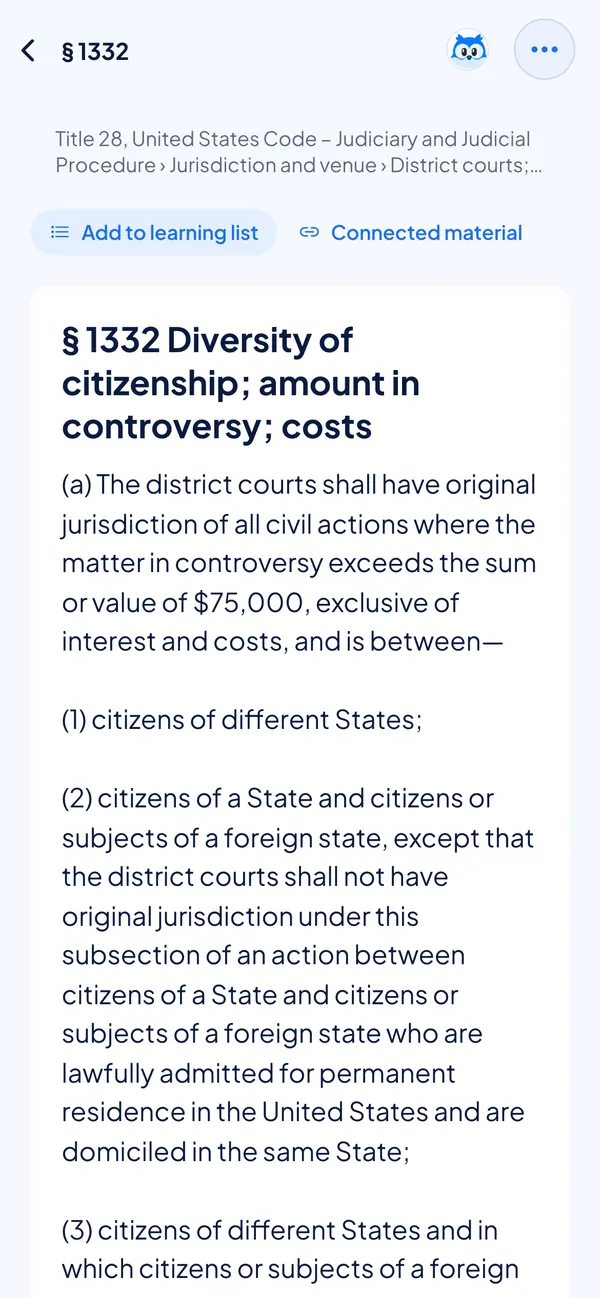
New in the app
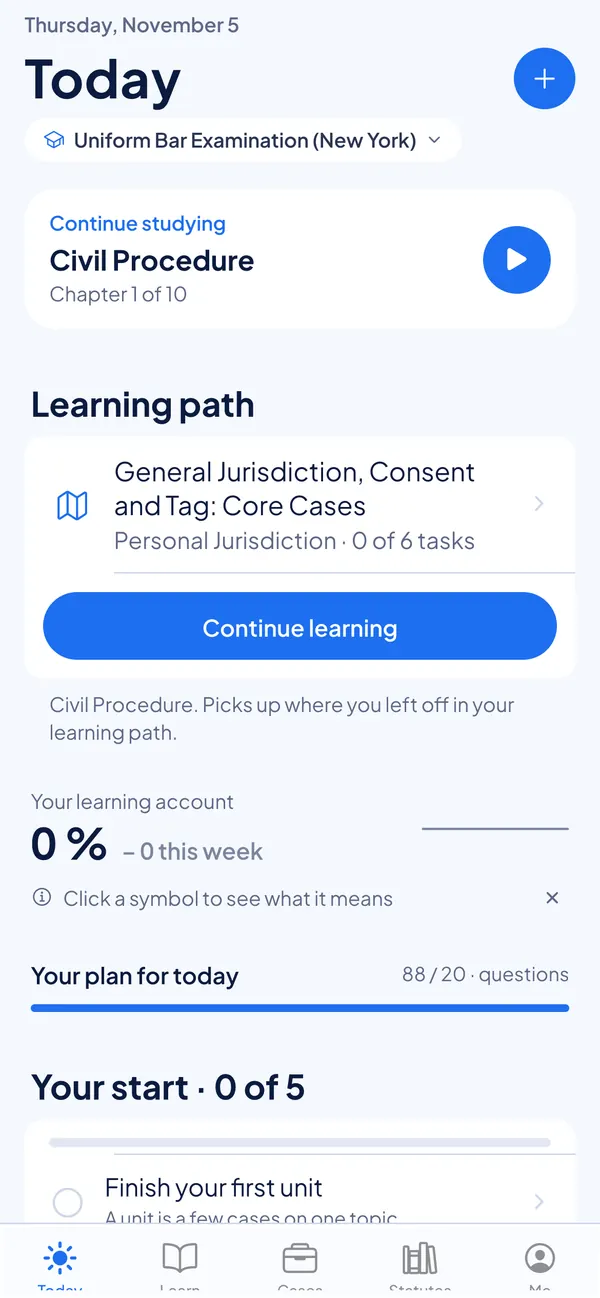
From your answers and cards across the whole course: which rules have not stuck yet, and what fits into one short unit for today. No AI call, straight from your own record.
Today for you
Cards that are due, questions on your weak rules and the next unit of your learning path, sized by your exam date and recent results. The same unit all day; recomputed after each session.
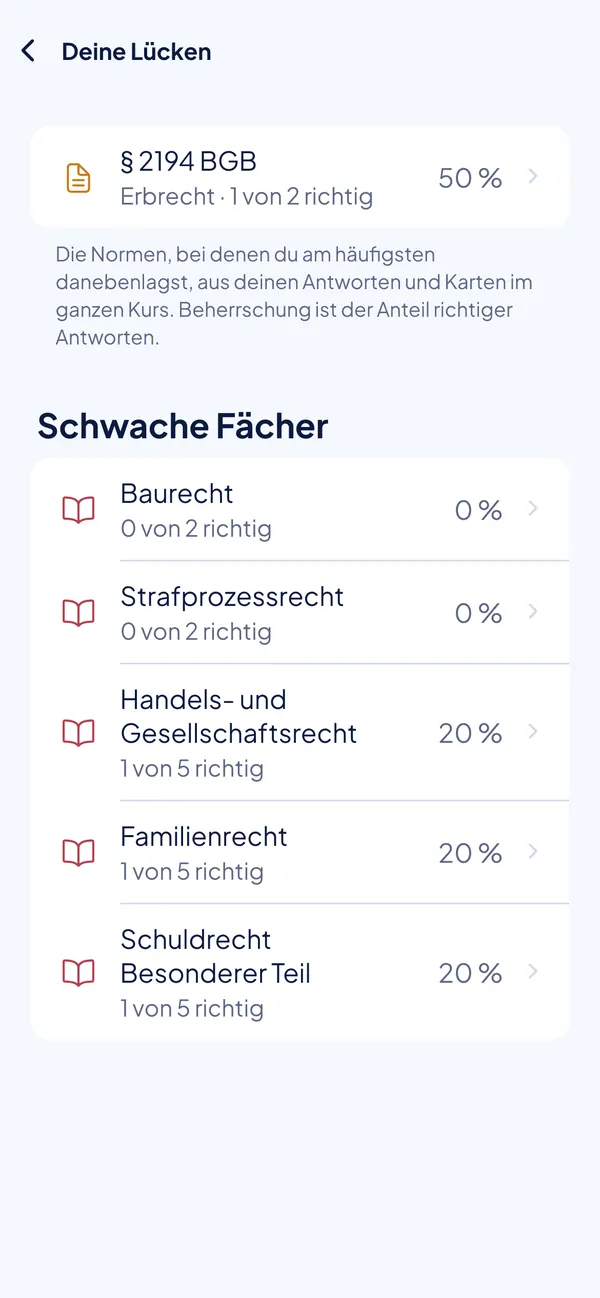
Weakness radar
The rules you missed most often, with your share of right answers. From each gap: practise five questions on it, read the rule in full or open the decisions that cite it.
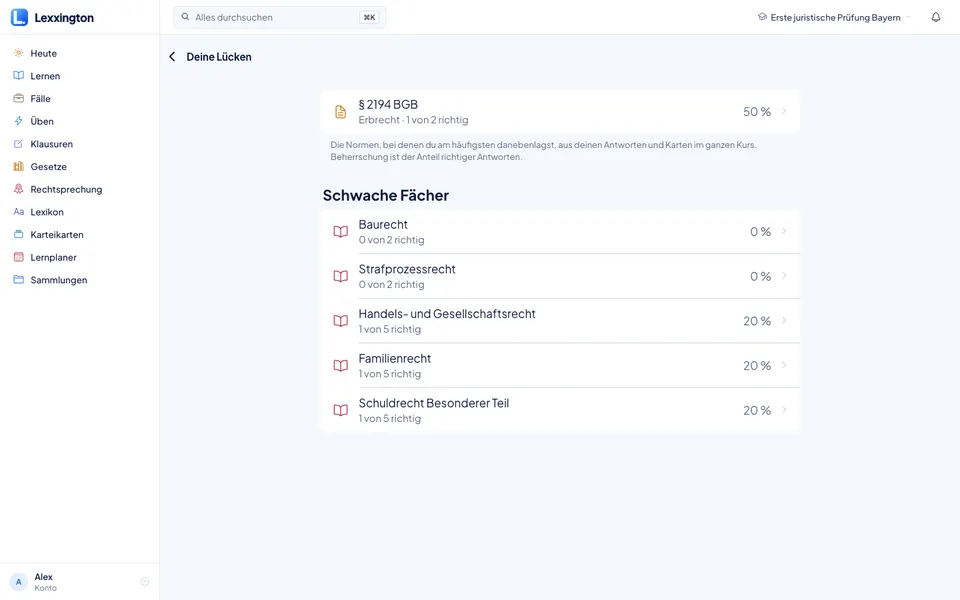
Real views from the web app with test data (the gaps view from the German course). In the app they show your own rules and numbers.
Step by step
Lessons are split into sections, each behind a card. You try it yourself first, then reveal. Then the learning path takes you to the next unit, with short checks in between.
Every section is a small test, not text to skim.
A few questions show whether the unit has stuck.
The learning path leads you through the material in a sensible order.
Business Law and Practice
Most BLP problems ask who decides (board or members), what majority is needed and what paperwork follows. Work through the decision in order: board meeting to approve and convene, members' approval, then board meeting to implement, then filings.
Start today with “Today for you”
Ten to fifteen minutes, sized to your exam date.
Original study material written from public sources: the official text of the law and published case law.
Download Lexxington on the App Store for iPhone or iPad.
Sign in with your email address and choose the SQE.
With a subscription you can also study in your browser, with the same account and progress.
More than 1,100 cases, worked step by step: judge a statement, read the reasoning, look up the rule.
More than 2,500 questions, with an explanation for every answer.
More than 1,100 cards for rules and elements. What you forget comes back sooner.
The rules in full text, plus 100 leading cases you should know.
20 timed written exercises with a model answer.
 Lexxi, your AI tutor
Answers questions about the material and names the rules the answer relies on. Lexxi can be wrong, so check the rules it cites.
See which subjects are solid and where to spend your next hour.
The route in stages. Marked where Lexxington helps you.
With LexxingtonNot in the app
Any subject. A law degree helps with the knowledge, but it is not required.
FLK1 and FLK2: two exams of single-best-answer questions on functioning legal knowledge.
Practical legal skills: advocacy, interviewing, drafting, research and writing. Not covered yet.
Two years full time, or equivalent, with up to four employers.
Character and suitability, then admission as a solicitor of England and Wales.
Five common problems when studying for the exam, and what the app does about them.
Fixed class times do not fit every week.
Study in the app whenever it suits you. The study plan counts back from your exam date and adapts.
Rereading and highlighting feel productive but do little.
Recall instead of reading: every exercise asks for an answer. Cards come back spaced, and in lessons you try first yourself.
You do not know where the gaps are.
The weakness radar shows the rules you missed most often, and “Today for you” practises them.
Statutes and case law live apart.
The rule in full, and one tap away the cases and decisions that apply it.
AI answers sometimes invent rules.
Lexxi answers from the knowledge base and names its sources, so you can check every answer.
Of ten common study techniques, practice testing and spaced practice come out on top. Highlighting and rereading rank near the bottom.
Four well-supported findings from learning research and how the app applies them.
Testing yourself leads to much better retention after a week than rereading the same text.
Cards, questions and cases ask for your own answer every time.
A meta-analysis of hundreds of studies: reviews spread out over time give more durable knowledge than the same time in one block.
The app schedules every card again: what holds comes back later, what is shaky sooner.
Tackling a problem yourself first, even without success, makes the explanation that follows stick better (productive failure).
Lessons sit behind cards: say it yourself, then reveal. Cases show the reasoning only after your answer.
A review of ten study techniques rates practice testing and distributed practice highest, highlighting and rereading low.
That is why almost every feature is a test, not a read.
Study the way research recommends
Recall, spaced review, practice on cases. All in one app.
To qualify as a solicitor in England and Wales you pass the Solicitors Qualifying Examination set by the SRA. SQE1 has two papers of functioning legal knowledge, FLK1 and FLK2, closed book, with single-best-answer questions from five options. From the January 2027 window each paper has 170 questions.
SQE2 then tests practical skills in 16 oral and written stations. Lexxington prepares you for SQE1; SQE2 is not covered yet.
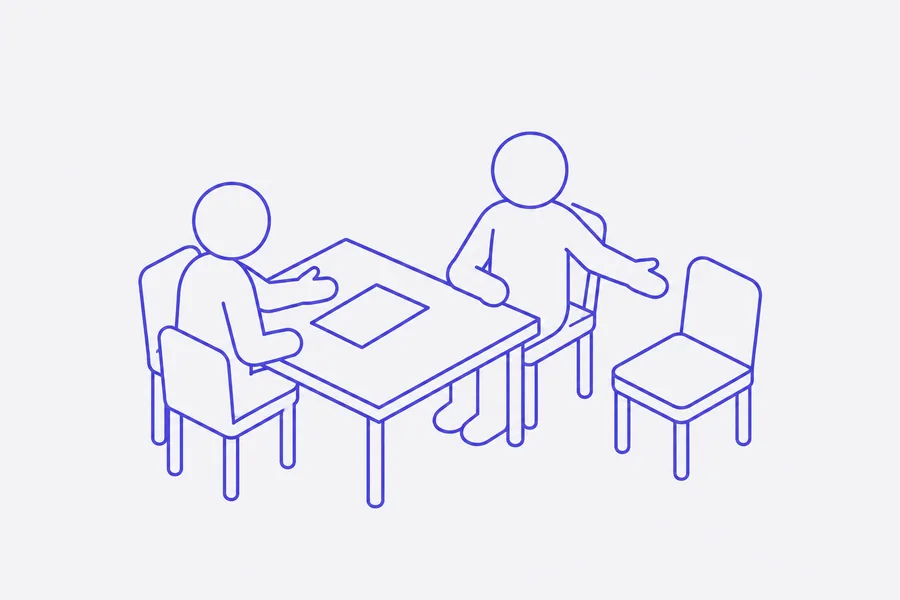
Mia, aged 15, is charged with theft from a shop in Portsmouth. She has no previous convictions. Her mother is unwilling to come to court. A local newspaper wants to report the case and name her.
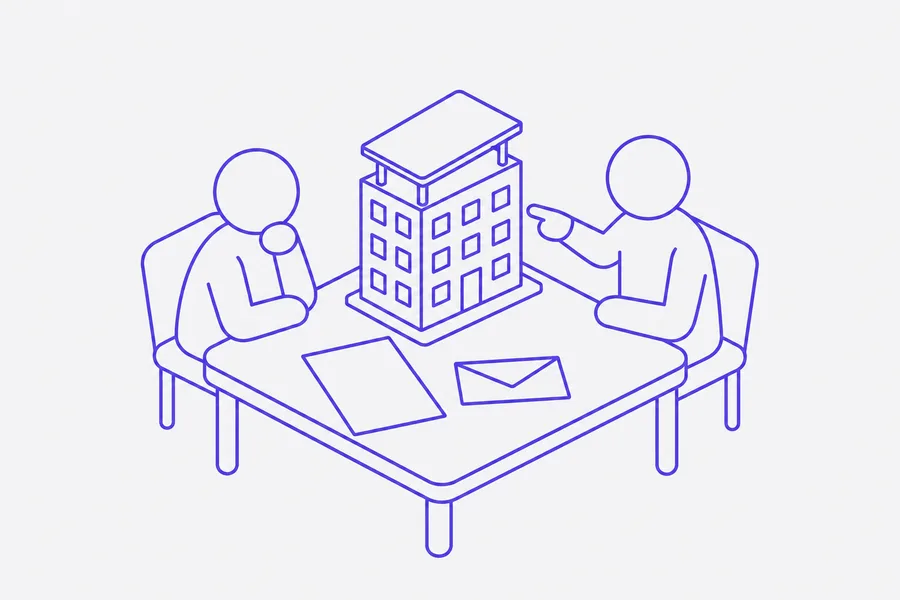
Helen already owns her home in York. She is buying a flat for 300,000 pounds to let to tenants. She will continue to live in her existing home. Her solicitor needs to calculate SDLT.
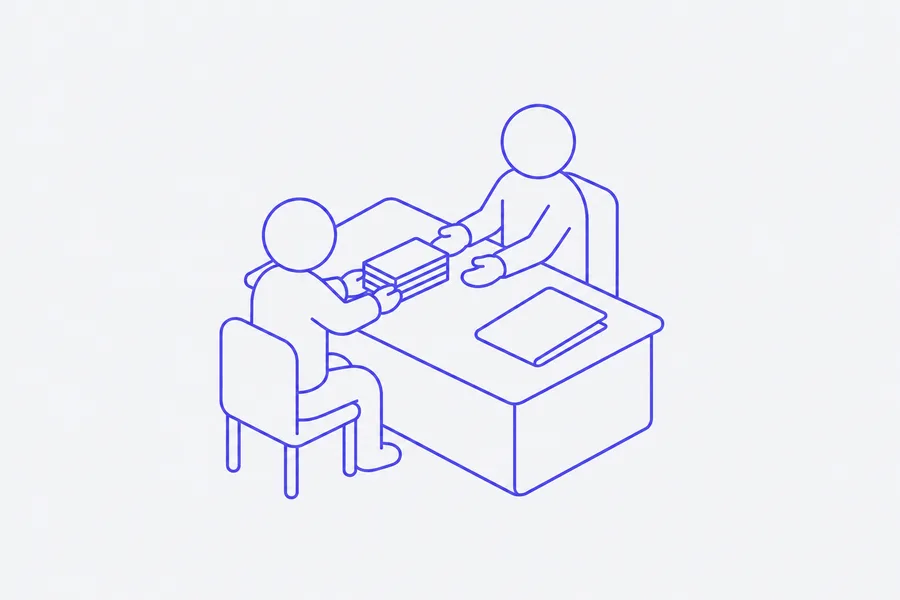
Ms Patel instructs Hale & Co on a boundary dispute with her neighbour. Before any work is done, she transfers £2,000 to the firm 'on account of costs'. No bill has been sent. The cashier asks how to deal with the money.

In the 2025/26 tax year, Betty gives her granddaughter £3,000 in May 2025. She gives her nephew £250 for his birthday and gives her son £5,000 when he marries. Betty made no gifts in 2024/25.
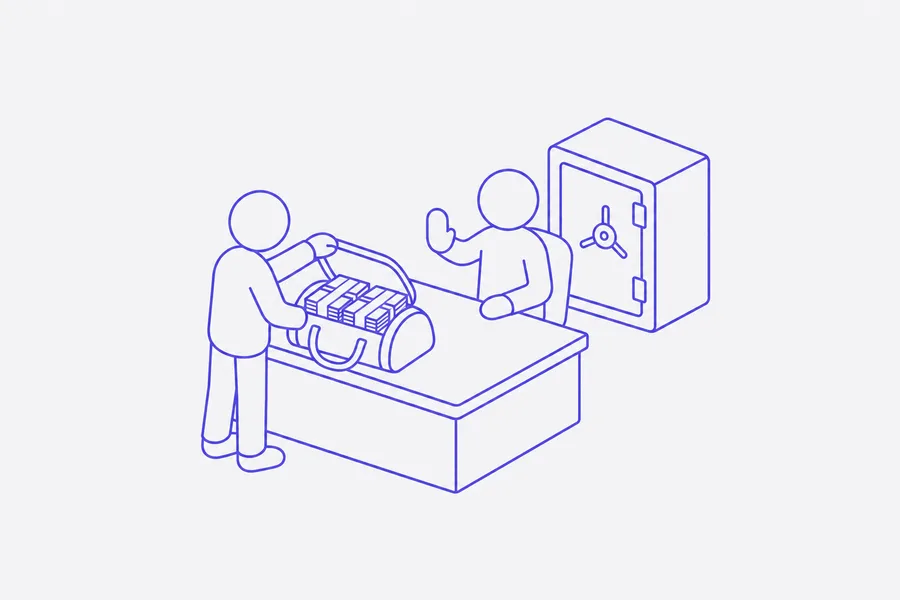
Hale & Co delivered a bill to Mr Hunt for £3,600 including VAT. Mr Hunt then sends a single payment of £6,000: £3,600 to pay the bill and £2,400 on account of future work. The cashier must decide where to pay the money.
Hale & Co sends Mr Zane a bill for £120 including VAT. Mr Zane mistakenly pays £1,200. The whole payment is received into the firm's business account. Mr Zane has no other matters with the firm.
Study content counted from the course files on every release, the knowledge base hourly from our pipeline. All figures rounded down. Knowledge base as of 5 November 2026.
The exercises follow methods that are well supported by learning research.
Every exercise asks for an answer from memory: flashcards test the rules, scenarios ask you to judge each statement.
The app schedules each card again. Cards you know come back later, shaky ones sooner.
The daily session mixes due, weak and new questions across FLK1 and FLK2 subjects, the way the papers do.
Short client scenarios judged statement by statement, with the rule, the authority and the reasoning after every answer.
Outlines, lectures and courses still matter. Lexxington works where knowledge usually slips away: recall and review.
Many students combine a course with the app. See the course and how the exam works.
Anything else? Write to us.
Support
hello [at] lexxington.com
Yes. The course follows every FLK1 and FLK2 subject of SQE1, with ethics and professional conduct throughout.
Not yet. The course prepares you for SQE1.
The SQE qualifies solicitors in England and Wales, and the course follows its specification. Scotland and Northern Ireland have their own routes, which the course does not cover.
Lexxi is the AI tutor in the app. It answers questions about the material and names the authorities it relies on. Lexxi can be wrong, so check what it cites.
No. All questions and scenarios are original study material written from public sources. Lexxington is not affiliated with the SRA or Kaplan.
On the App Store for iPhone and iPad. You subscribe in the app, where the price and term are shown before you buy. Subscribers can also study in the web app.
One 10 to 15 minute unit on the start screen: cards that are due, questions on your weak rules and the next unit of your learning path. It follows your exam date and recent results and is recomputed after each session.
The rules you missed most often, with your share of right answers. From there you practise five questions on the rule, read it in full or open the decisions that cite it.
Cases, questions, cards and lessons are original study material written from public sources. The rules are quoted from official texts, and decisions come from published case law.
Yes. On iPhone and iPad with the app, and with a subscription in the browser too, with the same account and progress.
Not necessarily. Many students combine both: the course for the overview, the app for daily recall, review and practice on cases.
No. Lexxi is a study aid and can be wrong. That is why every answer names the rules it relies on, so you can check them.
For iPhone and iPad. All content in the subscription in the app, plus the web app with the same account.